The skin is a barrier between our body and the outside world, protecting us from aggressors, retaining water and controlling our temperature. The skin has three layers: the epidermis, the dermis and the subcutaneous tissue.
As the skin ages, these three components undergo changes. Some changes are obvious: wrinkles appear and elasticity decreases. Indeed, our skin cells are no longer as efficient, the fibres (collagen and elastin) that give structure and elasticity to our skin are less numerous, melanomas fill up with melanin creating dark spots… The causes are numerous: internal, such as genetics, cell metabolism and hormonal changes (e.g. at menopause), but also external, including sun exposure (UV), pollution, chemicals, oxidative stress, regular sugar consumption, smoking, skin care, UV for example promotes the destruction of extracellular matrix fibres (collagen, hyaluronic acid) and damages mitochondria (part of the cell responsible for reducing oxidative stress, cell survival and energy production).
What about hair and nails?
Our hair and nails also age. Their growth, structure and colour change. In the hair, the fibres in the roots are weaker, the melanocytes responsible for colour function less well, and the follicle cells decrease in hair production. The nails are more fragile, thin and discoloured, the morphology of the nail plate (which grows the nail) changes and their lipid content varies with age.
This is a normal process, as the cells degenerate progressively, but oxidative stress and the environment (care, pollution, sun…) have a long-term effect.
What can be done to maintain beauty?
As the famous quote goes “You never get a second chance to make a first impression”, so every day is important in the quest for healthy ageing in general and skin ageing in particular.
We can act to avoid external factors that can have a negative effect on our appearance, because prevention is our ally: a healthy lifestyle can limit the harmful effects of this oxidative stress, notably through physical exercise, a low-stress environment (which also has a positive effect on cardiovascular disease, the immune system and neuropsychiatric functions), appropriate sun exposure, good sleep and a healthy diet including plenty of plants.
Disclaimer of liability: The information published on www.swiss-alp-health.ch does not claim to be complete and is not a substitute for individual medical advice or treatment. It cannot be used as an independent diagnosis or to select, apply, modify or discontinue treatment of a disease. In case of health problems, it is recommended to consult a doctor. Any access to www.swiss-alp-health.ch and its contents is at the user’s own risk.
The brain works like a big computer. It processes the information it receives through the 5 senses, and sends back messages, conscious and unconscious, to the body. However, the functions of the brain go much further with the ability to think, make decisions and feel emotions. The size of the human brain can be estimated at two clenched fists and its weight is around 1.5 kg. On the outside, it looks a bit like a big walnut, with folds and crevices. Brain tissue is made up of about 100 billion neurons and a trillion cells that support and nourish the tissue (glial cells).
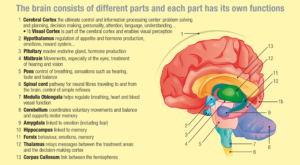
The brain is made up of different parts: the brain, the cerebellum and the brain stem. The brain, for the most part, is made up of the cerebral cortex (divided into 2 hemispheres, right and left, which themselves can be divided into lobes) as well as the thalamus, hypothalamus, amygdala, hippocampus… Then, moving closer to the spinal column, we find the other parts : cerebellum (at the back) and the brain stem (composed of the midbrain, the pons, and the medulla), and finally, we reach the spinal cord.
Each part has its own functions: movement coordination, spatial orientation, problem solving and planning, emotions, decoding of sensory information, attention, language, memory, appetite or sleep control, reflexes and reward mechanisms, control of unconscious activities such as blood glucose levels, hormone production, respiratory or cardiac rhythm…1,2
Neurons and information transmission
A neuron is a cell composed of a “body” (like all cells, with a nucleus containing DNA and organelles for the synthesis of proteins and energy), small receptor “arms” called dendrites and a long transmitter “arm” called an axon. A neuron will pick up different types of information or stimuli and transport them as an electrical signal (the myelin around the axon allows rapid transport). On arrival, the electrical signal allows the release of neurotransmitters (chemical molecules). These will end up in a small space between 2 neurons, called a synapse, and then bind to the next neuron. If there are enough neurotransmitters that bind to the receptors of the 2nd neuron, the activation threshold will be exceeded and an electrical signal will be created and propagate to the end of this neuron, releasing neurotransmitters in a new synapse, etc. There are also inhibitory neurotransmitters (e.g. GABA), which aim to prevent activation of the 2nd neuron. Finally, specific neurotransmitters allow the transmission of specific information (dopamine – for motivation/reward system, decision of movements, serotonin -stability, inhibition-, acetylcholine -muscle contraction, memory-, noradrenaline -regulation of metabolism, attention, learning- … ).3,4,5
How does vision work ?
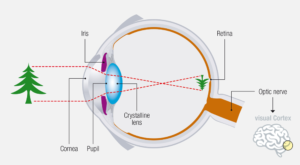
How do our eyes and brain work together to transform light into an image? Light rays enter the eye through the cornea, the transparent layer on the outside of the eye, and then pass through the pupil in the centre of the iris. The iris has the ability to enlarge and shrink, depending on the amount of light entering the eye. The light rays then pass through the natural crystalline lens of the eye, which shortens or lengthens to focus the light rays correctly on a specific point on the retina. The retina captures all the light rays thanks to two types of cells: the rods are sensitive to the intensity of the light, and the cones are used to see colours (they are activated by green, red or blue). The cells that are activated send an electrical signal towards the optic nerve. The signals coming from each eye meet at the optic chiasm and then divide again according to the visual field (the left part of the image – coming from both eyes – goes to the right hemisphere of the brain and vice versa). These optical fibres then go to the back of the brain, in the visual cortex part of the occipital lobe, where the information will be decoded.6, 7,8
Aging of the brain
As we age, the brain changes at all levels. The morphology is different: the volume decreases (from -5% per decade after 40 years old, especially in the prefrontal cortex which regulates reasoning, and part of the personality and emotions), the vascularisation changes, irrigating certain areas less, etc. Modifications are also found at the level of cells (slower transmission of information -demyelination-), synapses (changes/loss of connections) and molecules (reduced secretion of neurotransmitters and hormones).
Fortunately, the brain remains plastic and some losses can slow down or even improve with time and training. Certain factors such as regular exercise, healthy nutrition and a limited alcohol intake, seem to be beneficial in keeping the brain functional. Thus, according to article “Dietary and Lifestyle Guidelines for the Prevention of Alzheimer’s Disease,”11 published in 2014 in the scientific journal Neurobiology of Aging: “Vegetables, legumes (beans, peas and lentils), fruits and whole grains should replace meats and dairy products as a basic part of the diet”.
This article is intended to summarize the basics of how a part of the human body works, but in no way replaces medical diagnosis and treatment.
Disclaimer of liability: The information published on www.swiss-alp-health.ch does not claim to be complete and is not a substitute for individual medical advice or treatment. It cannot be used as an independent diagnosis or to select, apply, modify or discontinue treatment of a disease. In case of health problems, it is recommended to consult a doctor. Access to www.swiss-alp-health.ch and its contents is at the user’s own risk.
Anatomie du cerveau et du système nerveux – Fédération pour la Recherche sur le Cerveau (FRC). https://www.frcneurodon.org/comprendre-le-cerveau/a-la-decouverte-du-cerveau/anatomie-du-cerveau-et-du-systeme-nerveux/.
How does the brain work? – InformedHealth.org – NCBI Bookshelf. https://www.ncbi.nlm.nih.gov/books/NBK279302/.
How do neurons work? – Queensland Brain Institute – University of Queensland. https://qbi.uq.edu.au/brain-basics/brain/brain-physiology/how-do-neurons-work.
How does a neuron work? https://www.wingsforlife.com/en/latest/how-does-a-neuron-work-562/.
Comprendre le cerveau et son fonctionnement – Institut du Cerveau. https://icm-institute.org/fr/actualite/comprendre-le-cerveau-et-son-fonctionnement/.
How the Human Eye Works | Cornea Layers/Role | Light Rays. https://www.nkcf.org/about-keratoconus/how-the-human-eye-works/.
How Does Vision Work? – Video & Lesson Transcript | Study.com. https://study.com/academy/lesson/how-does-vision-work.html.
Bâtonnets et cônes | Ask A Biologist. https://askabiologist.asu.edu/batonnets-et-cones.
Peters, R. Ageing and the brain. Postgraduate Medical Journal vol. 82 84–88 (2006).
What happens to the brain as we age? https://www.medicalnewstoday.com/articles/319185#Recent-discoveries-in-brain-aging.
Barnard, N. D. et al. Dietary and lifestyle guidelines for the prevention of Alzheimer’s disease. Neurobiology of Aging vol. 35 S74–S78 (2014).
Oxidation is a chemical reaction that takes place in the presence of oxygen. You can see it when you cut an apple: once cut, the apple tends to turn brown because one of its enzymes reacts with oxygen and transforms a molecule (called phenol) into another molecule (called quinone) which will decompose into a brown pigment. The addition of lemon juice will slow down this browning because it contains vitamin C, a strong antioxidant, which will reduce the quantity of quinones and thus prevent the brown pigment from appearing.
It is the same balance between oxidation and anti-oxidation that takes place in each of our cells. Of course, we need oxygen to live and each of our cells uses it in many processes. During some of these reactions, for example when ATP cell energy is produced, free radicals (ROS – reactive oxygen species) are formed. Their presence – in small quantities – is normal, and they have certain functions such as communication between cells, the synthesis of cellular components or as a weapon of the immune system against pathogens. At the same time, ROS are constantly detoxified by certain antioxidant enzymes or by other mechanisms, to become harmless products, such as water H2O.1,2 An oxidative balance is reached, and normally works very well! Except that this is not always the case…
It’s all a question of balance… Otherwise, it’s oxidative stress!
Oxidative stress is a phenomenon caused by an imbalance between the production and accumulation of free radicals (ROS) in cells and tissues, and our body’s ability to detoxify these reactive products.1
While the presence of ROS created by our cellular metabolism is normal, certain environmental factors, such as UV rays, ionizing radiation, pollutants, heavy metals, tobacco, alcohol, certain drugs and chemicals, contribute to a significant increase in the production of ROS. This large amount of ROS cannot be fully detoxified by our antioxidant defences, and this imbalance leads to cell and tissue damage. This is called oxidative stress.
To counteract this, there are also exogenous antioxidants which can react with ROS to render it harmless, prevent its production or activate antioxidant enzymes.1,2 Vitamins B2, C, E, selenium, copper, manganese, zinc and polyphenols in olive oil help protect cells from oxidative stress.
Why is oxidative stress negative?
When there is too much ROS in relation to our antioxidant defences, the membranes of our cells and our proteins, lipids, DNA etc. will be “attacked” and damaged.1 Changes in the DNA of a cell lead to a deregulation of its functions and “behaviour”, which will impact the tissue in which it is located.
Aging can be defined as “the progressive loss of function of our tissues”, and the repetition of damage due to excess ROS can therefore accelerate it. Thus, over time, if oxidative stress is not reabsorbed, damage accumulates, tissues are no longer able to maintain their homeostasis and become dysregulated.1 Moreover, with age, antioxidant defences are reduced, making us more sensitive to excess ROS.4
Fortunately, it is never too late to get involved in reducing oxidative stress in our bodies. The generation of exogenous ROS can be minimised by avoiding exposure to radiation, pollutants, heavy metals, tobacco and alcohol, certain drugs and chemicals.
Beneficial physical activity
Moderate and regular aerobic physical activity (long, low-intensity aerobic exercise using oxygen in the muscles) is also important to limit the accumulation of oxidative stress because it stimulates antioxidant defences, especially in the muscles. It is also essential for maintaining good health in general. However, high-intensity physical activity will increase oxidative stress in our bodies.4
Disclaimer of liability: The information published on www.swiss-alp-health.ch does not claim to be complete and is not a substitute for individual medical advice or treatment. It cannot be used as an independent diagnosis or to select, apply, modify or discontinue treatment of a disease. In case of health problems, it is recommended to consult a doctor. Access to www.swiss-alp-health.ch and its contents is at the user’s own risk.
Pizzino, G. et al. Oxidative Stress: Harms and Benefits for Human Health. Oxidative Medicine and Cellular Longevity vol. 2017 (2017).
Burton, G. J. & Jauniaux, E. Oxidative stress. Best Practice and Research: Clinical Obstetrics and Gynaecology vol. 25 287–299 (2011).
Birben, E., Sahiner, U. M., Sackesen, C., Erzurum, S. & Kalayci, O. Oxidative stress and antioxidant defense. World Allergy Organization Journal vol. 5 9–19 (2012).
Liguori, I. et al. Oxidative stress, aging, and diseases. Clinical Interventions in Aging vol. 13 757–772 (2018).
Salim, S. Oxidative stress and the central nervous system. Journal of Pharmacology and Experimental Therapeutics vol. 360 201–205 (2017).
A short introduction to the function of our immune system
What is a pathogen ?
Bacteria are organisms constituted of one cell (size in µm: one millionth of a meter) and are able to grow and reproduce. Viruses are smaller (size in nm: one billionth of a meter) and are constituted of an envelope with some proteins and genes inside. To fulfil their objective to reproduce, they need to invade a cell and hijack its mechanisms. Many microorganisms live with us in harmony (commensals), but some of them can damage our tissues, which make them pathogens.
What is the immune system ?
The immune system is composed of many different cells (white blood cells = leukocytes), mechanisms and molecules, which help our body fight against any foreign body, such as viruses, fungus or bacteria. Our immune system also fights against other physical aggressions to our cells (shocks, toxin, acids, dust…).
First : cutaneous barrier
Our first protection is physical, in particular the skin, the mucosa and the digestive tract. The presence of mucous, healthy bacterial flora, some chemical molecules like enzymes and anti-microbial peptides help to defend us too. Some of our organs can also expel pathogens : lungs through coughing and sneezing, urinary tract, eyes through tears…
Second : innate immunity
Then, we have immune cells scattered through our body, which guard our tissues. So, when a pathogen succeeds to enter our body and begins to multiply, our immune cells will often rapidly detect it and fight it. This first line of defence is called innate immunity. Cells from innate immunity (macrophages, neutrophils, NK cells, dendritic cells…) will begin an immediate and non-specific fight by secreting damaging molecules and engulfing (phagocyting) pathogens. The cells already on-site will attract more cells by releasing chemical mediators (cytokines, chemokines…) to inform the body about the site of the infection. This will induce inflammation, which symptoms are redness, heat, pain and swelling, caused by an increased blood flow and an infiltration of immune cells in the attacked tissue. Note that inflammation is a good thing at this point because it helps us fight the pathogen and activates the innate immune system (only chronic inflammation, often due to our lifestyle or to chronic disease, is a problem, because our body is constantly fighting).
Sometimes with fever : why ?
Our body can increase its temperature to try to neutralize pathogens, which are often heat sensitive. Thus, a mild fever is usually not a problem and can even be beneficial. The best thing to do is to rest and stay hydrated. Nevertheless, a temperature higher than 38°C needs to be monitored and you should contact your doctor, to find the cause of the infection and eventually take antipyretics.
Third : adaptative immunity
Rapidly, some of the cells* present on-site will englobe and “eat” the pathogen (phagocytosis), degrading it into small pieces. They will then migrate towards the closest lymph node or the spleen, to inform the rest of the immune system about the type of infection occurring. The aim is to create a response which is specific to the invading pathogen, called adaptative immunity. The lymphocytes are mainly the cells taking care of this kind of immune reaction. We have two types of lymphocytes: T cells, which are especially good at dealing with problems inside the cells (for example cells infected by a virus or cancer cells) and B cells, which generally take care of problems in our fluids (often bacteria). We have a high number of lymphocytes in our body and each one of them is a little different from another, which enables our body to react against all kinds of pathogens. All of them circulate in our lymphatic system, and thus pass through the lymph nodes. When our phagocytic cells* arrive in the lymph node, they will present the little pieces of the destroyed pathogen and test every lymphocyte to find the exact one which can react against it. Once the appropriate lymphocyte has been found, it will be multiplied and activated. If the pathogen is a bacteria, it will be a role for B cells (humoral immunity), which will multiply and mature (becoming plasma cells) and then be able to secrete antibodies. These antibodies will stick to the pathogens, immobilise them, and allow other killing cells like macrophage to target the invading pathogen. If the pathogen is a virus, selected T cells will go to an organ called the thymus to multiply and be activated (cell-mediated immunity). Some of these T-cells will then be able to bind the infected cells and release molecules to kill them, other T-cells will stimulate other immune cells to improve their response and some will regulate them so as to avoid damaging the tissues.
It is important to know that this specific adaptative immune response takes almost a week to be ready.
After the infection: an enhanced protection next time, thanks to memory lymphocytes
Once the infection is defeated, everything comes back to normal, but the body will still keep a memory of this infection, through memory lymphocytes. Thus, if the same pathogen infects us again, our body can react much faster and more efficiently. Vaccination uses this principle to train our body to fight against a pathogen and be able to kill it fast in case a real infection begins.
The immune response can be hijacked
Unfortunately, some pathogens evolve and are able to avoid detection by our immune system, neutralize our immune response or even use it to their own advantage.
What to do when an infection occurs ?
The body needs plenty of rest and to stay well hydrated. Contact your doctor for a precise diagnosis and treatment. Be aware that antibiotics work against some bacteria, but never against viruses, so avoid self-medication.
Please note that there are many other cells that can be implicated in our immune response and that the interactions between the different mechanisms are infinitely more complex. This document is just meant to highlight the main phases of the immune response to an infection.
This article is intended to summarize the basics of how a part of the human body works, but in no way replaces medical diagnosis and treatment.
Disclaimer of liability: The information published on www.swiss-alp-health.ch does not claim to be complete and is not a substitute for individual medical advice or treatment. It cannot be used as an independent diagnosis or to select, apply, modify or discontinue treatment of a disease. In case of health problems, it is recommended to consult a doctor. Access to www.swiss-alp-health.ch and its contents is at the user’s own risk.
a
Aeberli, I. et al. Low to moderate sugar-sweetened beverage consumption impairs glucose and lipid metabolism and promotes inflammation in healthy young men: A randomized controlled trial. American Journal of Clinical Nutrition94, 479–485 (2011).
Joseph, S. v., Edirisinghe, I. & Burton-Freeman, B. M. Fruit Polyphenols: A Review of Anti-inflammatory Effects in Humans. Critical Reviews in Food Science and Nutrition56, 419–444 (2016).
Skeletal striated muscles bind bone through tendons. By contracting, they allow the voluntary movement of the skeleton in a specific direction. These contractions are controlled by motor neurons which connect the spinal cord and the muscles. Their activation leads to the release of calcium, which will bind to contractile proteins. Each muscle fibre (or myocyte, muscle cell) comes from the fusion of myoblasts, and contains between 2 and 500 nuclei at its periphery. It can no longer divide, but can increase its size by increasing the volume of the cytoplasm. Inside each muscle fibre, there are mostly myofibrils, which are the contractile units of muscle, composed of actin, myosin, troponin and tropomyosin.
Muscle mass loss with aging
Our muscles allow us to perform many movements and to mobilise our body, but also to maintain balance and posture, and to produce heat.
The muscle mass decreases with age and our strength decreases in parallel (from 10 to 15% per decade up to 70 years, from 25 to 40% after). Some metabolic changes greatly contribute to this decrease. Muscle protein breakdown is a normal physiological process, which is offset by the synthesis of new proteins in young people. As we age, protein synthesis decreases while protein degradation remains constant, resulting in reduced muscle turnover and reduced healing capacity. In addition, there’s a decrease in physical activity, a drop in hormone levels, some nutritional deficits, and chronic inflammation, which also contributes to the complex change in body composition.1
Taking care of our muscles
We can act to maintain and increase our muscular mass.
Our muscles are plastic and are fortunate enough to adapt to their demands throughout our lives. For example, some studies have shown that people between 60 and 80 years old, following an appropriate endurance training, can increase their aerobic capacity by 20 to 30%, which is like the performance of younger people. These performances are coupled with an improvement of the cardiovascular system and an adaptation of the peripheral muscles.1,5 Elderly people respond very well to resistance exercises too, which allow them to increase their strength and muscle mass. For example, weight lifting 3 times a week for 12 weeks allows people over 60 y.o to gain strength and increase the total muscle volume, similar to the performance of younger people…6 This phenomenon was also observed in nonagenarians, who, following adapted lower body training, could increase their strength, their mass and muscular functions, thus increasing their stability and walking speed and duration.7
Appropriate nutrition
Although exercise is the most important intervention, sufficient protein intake helps to maintain and increase muscle mass. Current recommendations for adults are 0.8g/kg/day, or 52g for a person weighing 65kg or 64g for 80kg. However, it is often recommended that older people consume more than 1.2g/kg/day, or 72g for a 65kg person or 96g for 80kg. 10g of protein can be found in 300ml of yoghurt, 1.5 eggs, 50g of meat or fish, 100g of tofu, 40g of nuts… In addition, calcium, magnesium and vitamin D contribute to maintaining normal muscle function.
This article is intended to summarize the basics of how a part of the human body works, but in no way replaces medical diagnosis and treatment.
Disclaimer of liability: The information published on www.swiss-alp-health.ch does not claim to be complete and is not a substitute for individual medical advice or treatment. It cannot be used as an independent diagnosis or to select, apply, modify or discontinue treatment of a disease. In case of health problems, it is recommended to consult a doctor. Access to www.swiss-alp-health.ch and its contents is at the user’s own risk.
Siparsky, P. N., Kirkendall, D. T. & Garrett, W. E. Muscle Changes in Aging: Understanding Sarcopenia. Sports Health6, 36–40 (2014).
Landi, F. et al. Prevalence and Risk Factors of Sarcopenia Among Nursing Home Older Residents. The Journals of Gerontology Series A: Biological Sciences and Medical Sciences67A, 48–55 (2012).
Sarodnik, C., Bours, S. P. G., Schaper, N. C., van den Bergh, J. P. & van Geel, T. A. C. M. The risks of sarcopenia, falls and fractures in patients with type 2 diabetes mellitus. Maturitas109, 70–77 (2018).
Landi, F. et al. Sarcopenia as a risk factor for falls in elderly individuals: Results from the ilSIRENTE study. Clinical Nutrition31, 652–658 (2012).
Seals, D. R., Hagberg, J. M., Hurley, B. F., Ehsani, A. A. & Holloszy, J. O. Endurance training in older men and women. I. Cardiovascular responses to exercise. Journal of Applied Physiology Respiratory Environmental and Exercise Physiology57, 1024–1029 (1984).
Frontera, W. R., Meredith, C. N., O’Reilly, K. P., Knuttgen, H. G. & Evans, W. J. Strength conditioning in older men: Skeletal muscle hypertrophy and improved function. Journal of Applied Physiology64, 1038–1044 (1988).
Fiatarone, M. A. et al. High-Intensity Strength Training in Nonagenarians: Effects on Skeletal Muscle. JAMA: The Journal of the American Medical Association263, 3029–3034 (1990).
The tissues of cartilage, tendons, ligaments and skin have strong common features. In scientific language they are part of the “extra cellular matrix” and in everyday life they are known as “connective tissue”. The building blocks of connective tissue are the same for cartilage, tendons, ligaments and skin (especially in the subcutaneous layers, the hypodermis): collagen fibres, elastin fibres and proteoglycans.
Structural proteins
Structural proteins determine the shape and give strength to our tissues. Elastin and collagen are examples of structural proteins. Collagen is found in humans and animals, but not in plants. Collagen fibres are very resistant to traction and hardly stretch. It is the most widespread protein in the human body and is made up of amino acids assembled in a precise order, and those that are particularly represented are glycine, proline, hydroxyproline and hydroxylysine.
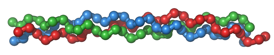
There are several types of collagen which have slightly different structures. Types 1 and 3 are particularly located in the skin, tendons, ligaments, bones and teeth. Type 2 collagen is largely located in the cartilage of the joints. Collagen is made up of three long protein chains that link together through disulphide bridges and hydrogen bonds. Together, these three long protein chains form a triple helix collagen (see drawing). Several triple helices of collagen form a fibril and several fibrils then form a collagen fibre.
Illustration: Collagen triple-helix
Amino acids
Amino acids are the smallest building blocks of proteins, such as collagen or elastin. A total of twenty types of amino acids are known today, which are found in all proteins in the human body. Of these twenty amino acids, eight are essential, i.e. the human body does not create them (isoleucine, leucine, lysine, methionine, phenylalanine, threonine, tryptophan, valine). When an essential amino acid is only available in insufficient quantities, the other amino acids cannot be used for the creation of new proteins and are transformed into fat and sugar. This is why the human body requires a sufficient amount of essential amino acids from the regular diet.
Proteoglycans
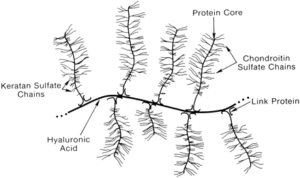
Proteoglycans are another component of connective tissue, like cartilage. Proteoglycans have a great capacity to bind water molecules. They give the connective tissue its typical gel-like consistency and enable it to feed the surrounding tissue and transport molecules to the cells. Proteoglycans are located between collagen and elastin fibres. The shape of the proteoglycans can be imagined as the trunk of a fir tree: the trunk is made up of hyaluronic acid and the branches are made up of chondroitin sulphates, dermatan and keratan (see illustration). Glucosamine is the precursor of these proteoglycans.
Illustration: Proteoglycan
Disclaimer of liability: The information published on www.swiss-alp-health.ch does not claim to be complete and is not a substitute for individual medical advice or treatment. It cannot be used as an independent diagnosis or to select, apply, modify or discontinue treatment of a disease. In case of health problems, it is recommended to consult a doctor. Access to www.swiss-alp-health.ch and its contents is at the user’s own risk.
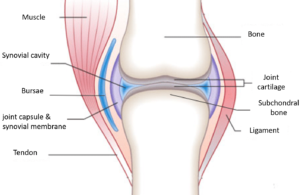
A joint is the point of connection between two (or more) bones. There are different types of joints, which have varying degrees of mobility. The knee, shoulder, hip and fingers are very movable joints, while the vertebrae are less movable, and the joints of the skull are immovable. The tolerated movements of the skeleton are delimited by the presence of ligaments, which connect the two bones and surround the joint capsule. The various movements are produced by the action of the muscle contracting and pulling on the tendon that attaches muscle to bone. Bursae facilitate the gliding motion between the various structures. They provide lubrication and absorb shock at pressure points of the bones, tendons and muscles near a joint.
The end of each bone is covered in a thin layer of articular cartilage, a pad of well-lubricated, smooth, elastic tissue. The space between the two cartilaginous ends contains synovial fluid, a clear, viscous fluid that serves to reduce friction by lubricating the joint and to absorb shock. Since cartilage is not vascularised, the synovial fluid also supplies oxygen and nutrients to the chondrocytes (cells) in the cartilage, eliminates metabolic waste, and contains phagocytes which destroy debris and microorganisms. The cartilage also receives nutrition via the subchondral bone, a layer binding bone to cartilage. It also supplies stem cells and structural molecules to the cartilage.
Disclaimer of liability: The information published on www.swiss-alp-health.ch does not claim to be complete and is not a substitute for individual medical advice or treatment. It cannot be used as an independent diagnosis or to select, apply, modify or discontinue treatment of a disease. In case of health problems, it is recommended to consult a doctor. Any access to www.swiss-alp-health.ch and its contents is at the user’s own risk.